· The Bloomfield Team
How Hydraulic Component Manufacturers Are Using AI in 2026
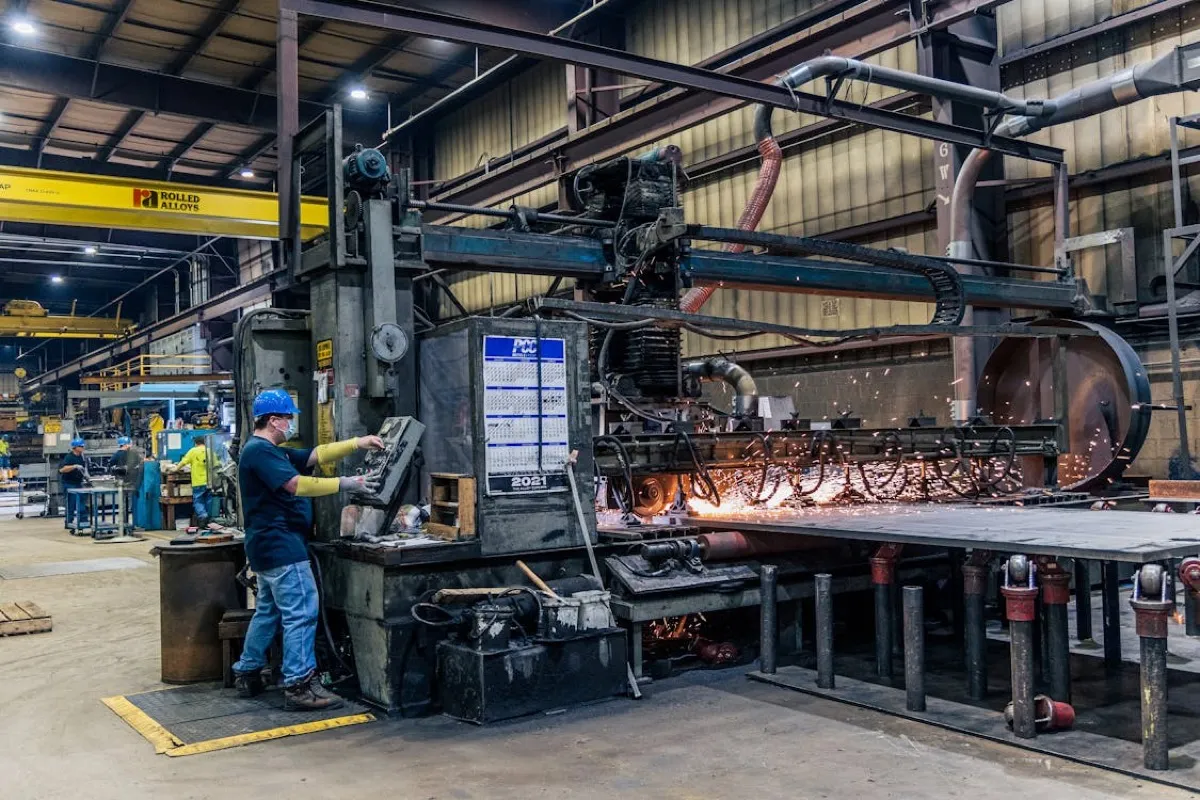
Hydraulic component manufacturing is a $15 billion domestic industry with roughly 2,800 manufacturers, most under 150 employees, producing manifolds, valve bodies, cylinders, pumps, and power units for markets from mobile construction equipment to aerospace actuation systems. The quoting challenge in hydraulics is distinct from general machining because the product complexity creates a combinatorial pricing problem that breaks standard estimating tools.
A single hydraulic manifold can have 8 to 40 ports, each with a specific thread type (SAE, BSPP, metric, JIC), orientation, and pressure rating. Internal flow paths between ports must be drilled at precise angles to connect circuits while maintaining minimum wall thicknesses. Material selection depends on system pressure, fluid compatibility, and temperature range. An estimator pricing one of these manifolds accounts for material removal rates on the specific alloy, the number and complexity of cross-drilled intersections, deburring requirements for internal passages, pressure test specifications, and surface finish on sealing surfaces.
That combination of variables is precisely where AI delivers measurable results.
The Quoting Problem in Hydraulics
A hydraulic manifold manufacturer processing 60 RFQs per month faces a math problem that compounds with every port and passage. A 12-port manifold with four separate hydraulic circuits requires the estimator to evaluate material cost based on the blank size needed to accommodate all port locations, then calculate machining time for each port (accounting for thread type, depth, and the specific tooling required), then add time for cross-drilling the internal flow paths (where each intersection requires careful speed and feed management to avoid breakthrough burrs), then factor deburring time for internal passages (which varies dramatically based on intersection geometry), then include pressure testing time based on the circuit count and test pressure, then account for any secondary operations like anodizing or zinc plating.
An experienced estimator can work through this in two to three hours. For a less experienced estimator, it takes a full day. At 60 RFQs per month, the quoting workload consumes one to two full-time estimators, and turnaround times stretch to four or five days.
For a deeper look at how these ideas connect across the shop floor, see our complete guide to AI in manufacturing.
The data to speed this up already exists. Every manifold that has been quoted and produced in the past five years contains the relationship between port count, circuit complexity, material type, and actual production time. The pattern that links a 16-port, 6-circuit manifold in 6061 aluminum with a specific set of machining operations and their associated times is buried in the ERP job records. The estimator accesses this pattern through memory and experience. AI accesses it through data.
AI-Assisted Manifold Quoting
A quoting tool built for hydraulic manifold manufacturing works differently from a general-purpose quoting system because the input variables are specific to the product.
When an RFQ arrives with a manifold drawing, the estimator inputs the key parameters: material, overall dimensions, port count and types, circuit count, test pressure, and any special requirements. The AI tool searches the historical database for the manifolds most similar across those parameters. It finds the three to five closest matches and presents them with their quoted prices, actual production costs, machining times by operation, and any notes about problems encountered during production.
For a shop that has produced 3,000 manifolds over five years, the system has a rich dataset to draw from. The patterns it identifies are specific and useful: 6061 aluminum manifolds with 8 to 12 ports and SAE thread configurations average 6.2 hours of machining time per unit. Steel manifolds with BSPP ports in the same port count range average 9.8 hours because of lower material removal rates and the additional time required for steel-specific tooling. Manifolds with cross-drilled intersections at angles below 60 degrees require 40% more deburring time than those with perpendicular intersections.
These patterns exist in every hydraulic manufacturer's job data. Without an AI tool, they exist only in the estimator's memory, which means they leave the company when the estimator does. With an AI tool, they are captured, structured, and available to every person who quotes.
Production Scheduling for Custom Hydraulics
Hydraulic component manufacturing is overwhelmingly make-to-order. Each manifold is configured to the customer's hydraulic circuit design. Repeat orders account for 30 to 45% of volume at most shops, which means the majority of production runs are first-article or low-quantity jobs that require setup planning, tooling verification, and first-piece inspection before production rates are reached.
AI scheduling in this environment addresses a specific bottleneck: the allocation of CNC machining centers based on the combination of part geometry, machine capability, and current queue depth. A 3-axis VMC can handle most port drilling and face milling. A 4-axis HMC is required for manifolds with ports on multiple faces that cannot be accessed in a single setup. A 5-axis machine is needed for manifolds with angular port orientations that exceed the 4-axis rotary range.
An AI scheduling tool analyzes the incoming job queue, matches each manifold's machining requirements to machine capability, and produces a load-balanced schedule that minimizes setup changes and machine idle time. For a shop running eight CNC machines across two shifts, this optimization typically improves machine utilization by 8 to 15% compared to manual scheduling. On $6 million in annual machine capacity, a 10% utilization improvement represents $600,000 in additional throughput without adding equipment.
Quality Prediction for Pressure-Critical Components
Hydraulic components operate under pressures ranging from 3,000 PSI for standard industrial applications to 10,000 PSI for aerospace and mobile equipment. Every manifold, valve body, and cylinder undergoes pressure testing before shipment. Failures at the pressure test station represent completed machining time that must be scrapped or reworked.
AI quality prediction analyzes the historical relationship between machining parameters, material lot properties, and pressure test results. The patterns are specific to hydraulic manufacturing: a manifold that was machined with a worn tool on the cross-drill operation is more likely to have internal burrs that cause a pressure test leak. A material lot with hardness at the upper end of the specification range correlates with longer tool life but also with more difficulty in achieving the required surface finish on seal faces.
A quality prediction model built on three years of inspection and pressure test data can flag jobs with elevated failure risk before they reach the test station. For a shop with a 4% pressure test failure rate on first test, reducing that to 2% by catching high-risk jobs earlier and adding inspection steps or process controls saves the cost of scrapped machining time, re-machining, and the schedule disruption that failures cause.
Tribal Knowledge in Hydraulic Manufacturing
The hydraulic industry faces the same workforce challenge as all of manufacturing: the people who know the most are approaching retirement. In hydraulic manufacturing, this knowledge is especially concentrated and specialized.
The senior machinist who knows that a particular cross-drill intersection geometry produces a burr that is invisible to visual inspection and only detectable with a borescope. The estimator who knows that a certain OEM's manifold drawings always underspecify the surface finish on their gauge port locations, and the actual requirement is 16 microinch Ra instead of the 32 called out on the print. The setup operator who has developed a specific fixturing approach for manifolds over 24 inches in length that reduces deflection during deep-hole drilling.
This knowledge has direct dollar value. The cross-drill burr knowledge prevents pressure test failures. The surface finish knowledge prevents rejections at incoming inspection. The fixturing knowledge saves 45 minutes per setup on large manifolds. Across a year of production, these individual pieces of knowledge are worth tens of thousands of dollars each.
An AI-powered knowledge capture system records these insights in a structured, searchable format. When a new operator sets up a job for a large manifold, the system surfaces the fixturing guidance from the senior operator. When the estimator opens a drawing from that OEM, the system flags the surface finish discrepancy. The knowledge stays in the operation even when the person who generated it does not.
Material and Supplier Intelligence
Hydraulic manifold manufacturers primarily work with 6061-T6 and 7075-T6 aluminum, ductile iron (65-45-12), carbon steel (1018, 1045, 4140), and stainless steel (303, 316) for corrosive environments. Material cost represents 15 to 35% of the total job cost depending on part size and material type. Price volatility in aluminum and steel directly impacts quoting accuracy and job margins.
An AI tool that tracks material pricing history from supplier quotes, correlates pricing with market indices, and predicts pricing direction over 30 to 90 day windows gives the estimator a meaningful advantage when building a quote. If the current aluminum price is $2.85 per pound and the model shows a pattern consistent with the price increases seen in Q3 2025, the estimator can factor an anticipated increase into a quote with a 60-day validity period. Without that insight, the estimator quotes at today's price and absorbs the increase if the customer orders at the end of the validity window.
Supplier lead time tracking provides a similar advantage. When the AI tool shows that the primary aluminum supplier's lead time has increased from 3 weeks to 5 weeks over the past quarter, the estimator adjusts the quoted lead time before the customer asks why the manifold is late. That proactive communication is worth more than the material savings because it preserves the customer relationship.
Where Hydraulic Manufacturers Start
The highest-value starting point for most hydraulic manufacturers is quoting. The product complexity makes quoting the most time-consuming process in the front office, and the data required for an AI quoting tool already exists in the ERP and in the estimator's files.
A typical implementation connects to the ERP to access historical job records, ingests the quoting spreadsheets and files where estimating formulas and notes live, and builds a recommendation engine that surfaces the most relevant past jobs when a new RFQ arrives. The tool does not replace the estimator. It eliminates the two to three hours of research the estimator currently does for each manifold quote and replaces it with a starting point built from the shop's own production history.
For a shop quoting 60 manifolds per month at an average of 2.5 hours of estimating time per quote, reducing that to 45 minutes per quote frees 105 hours of estimating capacity per month. At the estimator's loaded cost, that is $5,250 to $7,350 per month in recovered time. Applied to quoting more jobs, the revenue impact is substantially higher.
The tools to build this exist today. The hydraulic manufacturers who adopt them first will have a quoting speed advantage their competitors will spend years trying to replicate.
Related Field Notes
See what AI quoting looks like for hydraulic manufacturing
We will review your quoting workflow, assess your historical data, and show you how an AI tool built for hydraulic components would work in your operation.
Talk to Our Team →